Development log · Draft for approval
The People Behind the Kingdom
· Tyler Trahan
Characters give decisions a human context. Here is what relationships, advisors and family systems currently support.
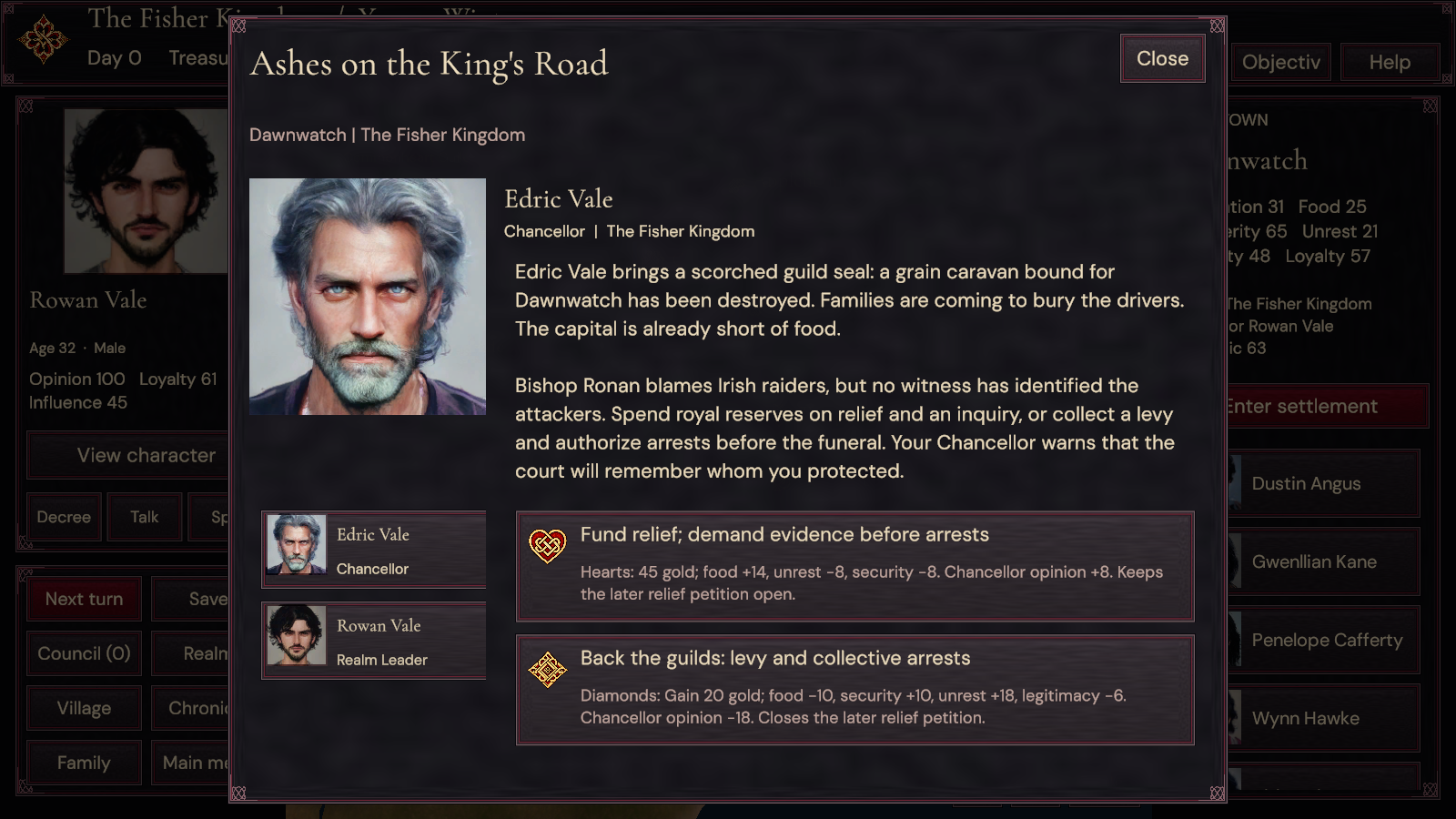
A kingdom becomes more interesting when the people in it want different things. For Royal Suit, I want a Council request to feel like something brought by a person with a position and a history. The map tells you where a problem is happening; the characters help explain why it matters, who supports a response, and who may remember it differently.
The current project stores characters, their opinion of the ruler, loyalty and family connections. Council effects can change a character’s opinion. In the grain-caravan example, funding relief improves the Chancellor’s opinion as well as changing town resources. That is implemented behavior. It gives a decision both a practical result and a personal consequence, without claiming that every character already has a fully authored reaction.
Advisors have persistent identities and roles. The project includes a Chancellor and other court advisors, and its services find those characters rather than inventing a fresh person whenever the Council opens. An advisor who has died is not simply recreated by that lookup. This matters because a recurring face should represent someone whose state persists through the reign, rather than a decorative portrait attached to a menu.
Family history also has a concrete foundation. Children can be connected to their parents, and deceased characters remain available to the historical record while leaving active settlement occupancy. Aging is tied to the passage of game years. These are working systems for maintaining continuity across time. They do not yet establish a finished set of family scenes, a complete relationship simulation, or a story for every household.
Succession currently includes a provisional heir-selection rule: it looks for eligible living descendants, works through the nearest descendant generation, and prefers the oldest, with a stable tie-break. That provides a basis for continuing a family’s rule. It should not be read as a promise of complete inheritance law, every foreign claim, or fully developed regency politics. Those situations need their own design and testing.
The story-condition system can use previous choices and character support to control which later content is available. My goal is for relationships to affect more than whether someone likes you: they should help shape information, options and story branches. The architecture supports that direction, but the authored content is still being completed. I want to show individual examples as they work rather than imply the whole narrative web is finished.
Royal Suit currently runs inside Unity, with no independently playable public build yet. The next step is to make these connected systems understandable in a coherent stretch of story, then test them with other people. Follow development to see that work and the people taking shape within it. Optional one-time support, once available, will help me reserve development time; it will not buy a character naming promise, a game key or an exclusive version of the updates.